
Composting is a biological process, so some odor generation is expected as organic material breaks down. The challenge for composting facilities is preventing those odors from becoming an off-site problem. When large volumes of odorous air need to be treated, biofiltration can be an effective option.
So, how do biofilters work for composting odors?
A biofilter uses naturally occurring microorganisms to treat contaminated air. Odorous air is collected from the composting process and directed through porous filter media. As the air passes through the media, odor-causing compounds are transferred to the moist surface where microorganisms can biologically break them down.
While the concept is fairly simple, successful biofiltration depends heavily on proper design and operating conditions.
At Webster Environmental Associates, Inc. (WEA), biofilters are evaluated as part of an overall odor-control strategy based on the characteristics of the facility and the air being treated.
How Odorous Air Moves Through a Biofilter
Before a biofilter can treat composting odors, the contaminated air first has to be captured.
Depending on the facility, covers, enclosures, ventilation systems, and ductwork may be used to collect air from odor-producing processes. That air is then distributed through the biofilter media.
Air distribution is important because the entire media bed needs to be used effectively. If airflow is uneven, some portions of the media may receive excessive loading while other areas receive very little. This can reduce treatment efficiency and make system performance less consistent.
The design therefore involves more than choosing a filter material. Airflow, pressure, media depth, loading rates, and the physical configuration of the system all have to work together.
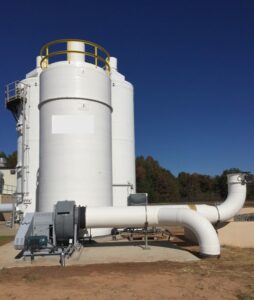 What Happens Inside the Biofilter?
Biofilter media provides an environment where microorganisms can live and grow. As contaminated air passes through the media, biodegradable odor compounds move from the air into the moisture surrounding the media.
Microorganisms then use those compounds as part of their biological processes, converting them into less objectionable end products.
This makes biofiltration different from technologies such as activated carbon adsorption, where contaminants are captured on the surface of the carbon. A biofilter relies on an active biological population to continually treat appropriate contaminants.
That biological component is also why maintaining the correct conditions inside the biofilter is so important.
Moisture Is Critical to Biofilter Performance
Microorganisms need moisture to remain active, and odor compounds need to transfer from the air into the moist environment surrounding the media before biological treatment can occur.
If biofilter media becomes too dry, biological activity and treatment performance can suffer. Uneven moisture can also create areas of inconsistent performance within the media bed.
Too much moisture can create its own problems by restricting airflow through the media.
A properly operated system therefore needs to maintain appropriate moisture conditions without saturating the media. Depending on the design, humidification or irrigation may be used to help maintain the environment needed for biological treatment.
Why pH Matters
The biological activity occurring inside a biofilter can change the chemistry of the media over time.
Certain contaminants can create acidic conditions as they are biologically oxidized. If the pH moves outside the range needed by the microorganisms, system performance may decline.
Monitoring and maintaining appropriate conditions within the media is therefore an important part of operating a biofilter successfully.
This is one reason biofilters should not be viewed as passive systems that can simply be installed and forgotten. They require attention to the biological and physical conditions that allow the treatment process to work.
Biofilters and Composting Operations
Composting facilities can generate large volumes of air with relatively low concentrations of biodegradable odor compounds, making biological treatment worth considering in many applications.
Odor may be generated during material receiving, mixing, active composting, aeration, turning, curing, or storage. The characteristics of the collected air can vary considerably depending on the material being composted and how the facility operates.
For this reason, the question is not simply whether biofilters work for composting odors. The more useful question is whether a biofilter is appropriate for the specific odor load and operating conditions of that facility.
The Media Has an Important Job
Biofilter media must provide both a surface for biological growth and enough open space for air to move through the system.
Over time, media can change physically and biologically. Compaction, deterioration, moisture distribution, and other conditions can affect airflow and performance.
When airflow begins finding easier paths through certain areas, contaminated air may not receive consistent treatment throughout the entire bed. Proper design, monitoring, and maintenance help reduce these problems and extend effective system operation.
Biofilters Are Not the Answer to Every Odor Problem
Biofiltration has advantages, but no odor-control technology is appropriate for every facility or every contaminant.
A composting facility may have several odor sources with very different characteristics. One source might be suitable for biological treatment while another requires a different approach.
Chemical scrubbers, biotrickling filters, activated carbon adsorption, covers, enclosures, and other technologies may also be considered depending on the application.
In some cases, the most effective solution may combine multiple technologies.
WEA is independent of odor-control equipment manufacturers. This allows treatment alternatives to be evaluated based on facility conditions and performance requirements rather than starting with a particular product or manufacturer.
Start with the Odor Source, Not the Equipment
Before designing a biofilter, it is important to understand what the system is expected to treat.
Odor assessments, source sampling, chemical analysis, and other evaluation methods can help characterize emissions and determine which processes are contributing most significantly to the odor problem.
Operational conditions should also be considered. Moisture, aeration, temperature, material handling, and other aspects of composting can influence odor generation before the contaminated air ever reaches treatment equipment.
Reducing unnecessary odor generation at the source can make the downstream odor-control system more effective and potentially reduce treatment requirements.
Designing Biofiltration Around the Facility
Understanding how biofilters work for composting odors is only the beginning. Successful performance depends on matching the system to the facility’s airflow, contaminants, odor loading, available space, operating conditions, and performance requirements.
Webster Environmental Associates provides specialized odor-control engineering services for municipal and industrial facilities, including odor evaluation, technology selection, system design, construction engineering, performance testing, and operational assistance.
If your composting facility is considering a new biofilter or experiencing problems with an existing odor-control system, contact Webster Environmental Associates to discuss the facility and determine whether biofiltration is an appropriate approach for the application.