Odors from sludge handling and dewatering processes are among the most persistent and challenging issues in wastewater treatment facilities. As biosolids are thickened, conditioned, and pressed, they release volatile gases that can quickly affect air quality within and beyond the plant.
Webster Environmental Associates, Inc. (WEA) provides advanced sludge dewatering odor control solutions that address these emissions at the source. Our data-driven approach and decades of experience help facilities control odor, protect equipment, and maintain compliance—all while improving the work environment for operators and staff.
 Understanding Odor Sources in Sludge Dewatering
Sludge dewatering involves processes such as centrifugation, belt pressing, and filter pressing—each of which can generate high concentrations of hydrogen sulfide (H₂S), ammonia, and volatile organic compounds. These odors are not just unpleasant; they signal chemical reactions that can corrode infrastructure and pose safety concerns.
Common sources of odor during dewatering include:
- Thickened sludge storage tanks and hoppers.
- Centrifuge or belt press exhaust air.
- Polymer and chemical mixing areas.
- Conveyors, cake storage bins, and truck loading stations.
Because sludge composition and process configurations vary widely, Webster Environmental Associates begins every project with a detailed odor study to determine the exact nature and strength of emissions. This analysis ensures that each solution we design is precise, efficient, and sustainable.
A Scientific Approach to Odor Mitigation
At WEA, effective odor control begins with accurate data. Our engineers conduct air and liquid sampling to measure odor-causing compounds and assess system performance under real-world conditions.
This information allows us to:
- Identify the primary emission sources and their relative intensity.
- Quantify airflow and hydrogen sulfide levels.
- Determine appropriate collection, containment, and treatment strategies.
- Develop cost-effective alternatives backed by measurable performance data.
By applying these findings, WEA creates odor control systems that perform predictably and require minimal maintenance over time.
Odor Control Technologies for Sludge Dewatering
1. Gas-Phase Treatment Systems
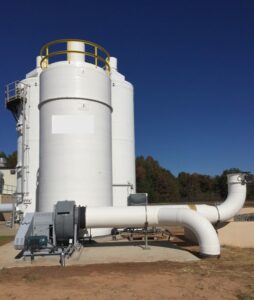
Most dewatering odor control strategies focus on capturing and treating foul air from centrifuges, conveyors, and cake storage areas. WEA designs several types of gas-phase systems tailored to each facility’s needs:
- Biofilters: Low-maintenance systems that biologically break down odor compounds using a natural media bed.
- Biotrickling Filters: Ideal for higher loading conditions, providing continuous removal efficiency with automated control.
- Carbon Adsorbers: Compact and effective for smaller facilities or intermittent odor sources.
- Chemical Scrubbers: High-performance systems that use oxidizing chemicals to treat high-strength hydrogen sulfide and ammonia emissions.
Each system is engineered for airflow capacity, odor strength, and budget considerations—ensuring maximum efficiency at the lowest life-cycle cost.
2. Liquid-Phase Treatment and Chemical Control
In many cases, the key to odor reduction lies upstream. Liquid-phase treatment can prevent odor generation in sludge storage tanks and piping systems before dewatering begins.
WEA uses targeted chemical dosing solutions such as:
- Calcium Nitrate: Prevents anaerobic conditions that produce hydrogen sulfide.
- Iron Salts: React with sulfide ions to form stable, odorless compounds.
- Hydrogen Peroxide: Oxidizes odor-causing compounds and helps maintain aerobic conditions.
Our team evaluates each system’s flow rates, retention times, and loading patterns to optimize chemical application and minimize operating expenses.
3. Enclosed Design and Ventilation Optimization
Proper containment is critical for keeping odors under control. Open hoppers, conveyors, and transfer points can easily release gases into the surrounding environment if not designed carefully.
WEA’s engineers develop ventilation and containment systems that:
- Capture air at the point of release using localized hoods or full enclosures.
- Maintain negative pressure to prevent fugitive emissions.
- Direct air through ductwork to odor treatment units.
- Balance airflow across multiple collection points for consistent performance.
These systems are designed for safety, efficiency, and ease of maintenance—critical factors in continuous sludge processing environments.
Independent Expertise, Tailored Design
Because Webster Environmental Associates operates independently from equipment manufacturers, we remain unbiased when selecting odor control technologies. Our goal is not to sell equipment—it’s to deliver the most effective engineering solution for each facility.
This independence allows us to compare the performance, cost, and maintenance requirements of different technologies objectively. Whether a biofilter, chemical scrubber, or hybrid system is best suited, clients can trust WEA to recommend what will truly work long-term.
Proven Results Through Experience
With more than 750 odor control projects completed across the United States and abroad, WEA has become a trusted partner for municipalities, engineering firms, and private industries. Our engineers bring over 100 years of combined experience to every project, delivering solutions that perform reliably under real-world conditions.
We have successfully designed and implemented odor control systems for sludge dewatering operations at facilities of all sizes—from small regional plants to major metropolitan utilities. Each design reflects our commitment to quality, innovation, and measurable performance.
 Supporting Clients from Design to Operation
At Webster Environmental Associates, odor control isn’t just about equipment—it’s about partnership. We support our clients through every phase of the project, including:
- Odor study and air sampling.
- System design and specification.
- Permitting and compliance support.
- Construction oversight and start-up assistance.
- Long-term operation and maintenance planning.
Our clients value that we stay involved beyond project completion, offering testing and performance evaluations to confirm continued system efficiency.
Benefits of Effective Sludge Dewatering Odor Control
Implementing a well-designed odor control system provides measurable advantages:
- Improved Community Relations: Reduced odor complaints and positive public perception.
- Extended Equipment Life: Prevention of corrosion caused by hydrogen sulfide.
- Regulatory Compliance: Meets local and state air quality standards.
- Operational Efficiency: Cleaner working conditions for plant personnel.
- Lower Lifecycle Costs: Reduced need for emergency maintenance or reactive fixes.
These benefits combine to create not only cleaner air but also more sustainable and cost-effective plant operations.
Partner with the Odor Control Experts
Sludge dewatering odor control requires technical precision and field-tested experience. Webster Environmental Associates delivers both. Our team designs customized, data-driven systems that reduce emissions, improve facility conditions, and protect community well-being.
If your facility faces persistent odor issues during dewatering or sludge handling, we can help you identify the root cause and implement a lasting solution.
Contact Webster Environmental Associates today to learn more about how our engineering expertise can improve performance and help your operations meet the highest environmental standards.