The pulp and paper industry is known for its essential role in producing paper products, but it also faces one of the most persistent challenges in industrial operations—odor control. Strong sulfur-based odors, often described as “rotten egg” smells, can impact plant workers, surrounding communities, and a company’s reputation.
At Webster Environmental Associates, Inc. (WEA), we provide advanced pulp and paper odor control solutions built on more than four decades of specialized experience. With over 750 odor control projects completed across three continents, we design, implement, and optimize systems that reduce odors, enhance compliance, and maintain community trust.
Understanding Odors in the Pulp and Paper Industry
Odors in pulp and paper facilities typically arise during the pulping and chemical recovery processes. The primary culprits are reduced sulfur compounds such as hydrogen sulfide (H₂S), methyl mercaptan, dimethyl sulfide, and dimethyl disulfide. These gases are produced during the breakdown of lignin and other organic materials used in pulping operations.
Additional odor sources may include wastewater treatment systems, sludge dewatering, chemical storage tanks, and evaporator condensate streams. Because these compounds are highly detectable at low concentrations, even small leaks or inefficiencies can result in noticeable odors extending beyond plant boundaries.
The Importance of a Comprehensive Odor Control Strategy
Odor mitigation in the pulp and paper sector cannot rely on a single method or technology. Each process within a facility has its own odor characteristics, flow rates, and emission points. An effective odor control strategy must address both point-source emissions, such as stack exhausts, and fugitive emissions from open tanks or vents.
At WEA, we begin every project with an odor evaluation—a scientific study that combines field measurements, air sampling, and chemical testing to identify and prioritize odor sources. Once data are gathered, our engineers perform air dispersion modeling to understand how odors travel under varying environmental conditions. This analysis forms the foundation for developing targeted, site-specific odor control solutions.
Engineering Customized Odor Control Systems
Because Webster Environmental Associates operates independently of all equipment manufacturers, we recommend and design odor control systems purely based on performance, reliability, and cost-efficiency.
Our pulp and paper odor control solutions may include a combination of gas-phase and liquid-phase technologies, depending on the identified emission points:
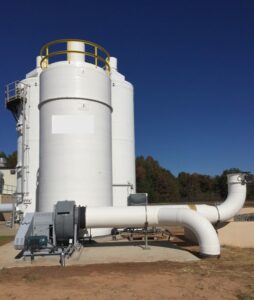
- Chemical Scrubbers: Effective for neutralizing hydrogen sulfide and sulfur-based gases using caustic or oxidizing solutions.
- Biotrickling Filters and Biofilters: Environmentally friendly systems that use natural microorganisms to break down organic and sulfur compounds in air streams.
- Activated Carbon Adsorbers: Highly efficient for polishing exhaust air and capturing residual odors after primary treatment.
- Mist or Vapor Phase Systems: Ideal for open areas, sludge handling facilities, or truck loading stations where diffuse emissions occur.
- Liquid-Phase Odor Control: Involves the addition of chemical agents, such as iron salts or magnesium hydroxide, to wastewater or sludge to prevent odor formation at the source.
- Each design is tailored to meet the facility’s specific operational requirements, ensuring effective performance without disrupting core production processes.
Integration with Existing Operations
Odor control systems in pulp and paper facilities must work alongside complex process equipment and variable airflows. WEA’s engineers design integrated systems that align with a facility’s layout, ventilation structures, and process schedules.
We analyze airflow paths, duct configurations, and exhaust collection points to ensure consistent capture and treatment of odorous gases. Our systems are engineered for long-term reliability with minimal operator intervention, reducing downtime and maintenance costs.
Testing, Monitoring, and Optimization
A critical step in odor management is verifying that installed systems achieve measurable results. WEA provides performance testing and ongoing system monitoring to confirm odor reduction effectiveness and compliance with environmental regulations.
Our testing protocols may include:
- Pre- and post-treatment air sampling to evaluate removal efficiency
- Hydrogen sulfide concentration tracking at critical points
- Flow and pressure monitoring to optimize system performance
- Periodic media testing for activated carbon and biofilter substrates
By combining these data with on-site performance observations, we help clients fine-tune their systems for maximum efficiency and long-term reliability.
Regulatory Compliance and Permitting
The pulp and paper industry operates under strict air-quality and environmental regulations. Many state and local authorities enforce nuisance odor standards that require continuous odor mitigation and documentation.
WEA assists clients in preparing air permitting applications, conducting regulatory reporting, and compiling compliance documentation that satisfies local, state, and federal requirements. Our engineers work directly with regulatory agencies to streamline approval processes and ensure that facilities remain in good standing.
Sustainability and Environmental Responsibility
Sustainability is at the core of modern pulp and paper operations, and odor control plays a significant role in that mission. WEA focuses on sustainable odor management through energy-efficient designs, reduced chemical use, and natural biological treatment options where possible.
Our systems not only control odors but also contribute to broader environmental goals such as reducing emissions, protecting worker safety, and promoting cleaner operations. By integrating odor management with sustainability initiatives, facilities demonstrate leadership in environmental responsibility.
 Community Relations and Reputation Management
Odor complaints can escalate quickly in nearby communities, often drawing negative attention from local media and regulators. Proactive odor control helps prevent these issues and fosters positive relationships with the public.
WEA supports clients by providing data-backed performance reports and clear communication tools that help explain mitigation efforts to the community. Demonstrating measurable results builds trust and reinforces a company’s reputation for environmental stewardship.
Why Choose Webster Environmental Associates
For more than 40 years, Webster Environmental Associates has been a trusted leader in odor control engineering for industrial, municipal, and manufacturing clients. Our combination of engineering expertise, regulatory knowledge, and independent approach ensures that every client receives a tailored solution built for lasting results.
We’ve completed hundreds of successful odor control projects across the pulp and paper sector and beyond, providing clients with the confidence that their facilities operate efficiently, compliantly, and responsibly.
Partner with WEA for Proven Odor Control
If your pulp or paper facility is experiencing odor issues or preparing for expansion, Webster Environmental Associates can help. Our team will assess your current systems, identify odor sources, and design a comprehensive, cost-effective odor control plan that delivers measurable results.
Reach out today to learn more about how our pulp and paper odor control solutions can strengthen your operations, compliance, and community relationships.