Industrial facilities play a vital role in manufacturing, production, and processing—but they often generate odors that can affect workers, nearby communities, and overall environmental compliance. These odors can originate from organic decomposition, chemical reactions, or specific manufacturing processes, making them complex to identify and control.
At Webster Environmental Associates, Inc. (WEA), we specialize in developing comprehensive industrial odor mitigation plans designed to address these challenges directly. With over four decades of odor control expertise and more than 750 successful projects completed across the United States and internationally, WEA delivers targeted, data-driven strategies that reduce odors, protect reputations, and maintain regulatory compliance.
The Need for Industrial Odor Mitigation
Odors in industrial environments are more than a nuisance—they can have serious operational and reputational consequences. Persistent odors often trigger community complaints, disrupt workplace environments, and attract regulatory attention. Certain odor compounds, such as hydrogen sulfide, volatile organic compounds (VOCs), and amines, can even cause corrosion or health-related concerns if left unchecked.
A structured odor mitigation plan provides the roadmap facilities need to identify emission sources, measure their impact, and implement proven solutions. Rather than reacting to complaints or violations, a proactive odor plan allows businesses to manage emissions effectively, maintain compliance, and strengthen community relationships.
 Developing a Data-Driven Odor Mitigation Strategy
Every industrial odor mitigation plan begins with a detailed assessment of the facility’s operations. WEA’s engineers conduct comprehensive odor studies that include air and liquid sampling, on-site evaluations, and laboratory testing. By measuring odor compounds under real-world operating conditions, we can identify the exact locations and processes responsible for emissions.
Our evaluations often incorporate odor panel analysis and chemical testing to quantify both concentration and character—understanding not just what compounds are present, but how noticeable they are to the human nose. This dual approach provides a complete picture of the odor problem and allows for precise, targeted solutions.
Once data are collected, our team models how these emissions disperse in the atmosphere using advanced air dispersion modeling. This process helps visualize how odor concentrations vary across distances and weather conditions, predicting where odors are most likely to cause impact.
Designing Practical and Cost-Effective Solutions
The key to a successful odor mitigation plan lies in matching the right technology to the specific odor challenge. Because Webster Environmental Associates is an independent consulting firm—not tied to any equipment manufacturer—we design systems based purely on performance, reliability, and cost-efficiency.
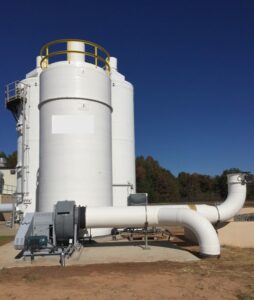
Depending on the facility’s needs, we may recommend gas-phase treatment technologies such as chemical scrubbers, biotrickling filters, or carbon adsorption systems. For liquid-phase control, we may suggest chemical additives or aeration adjustments to prevent odor generation at its source.
WEA’s engineers also evaluate ventilation systems, process modifications, and containment measures to minimize odor release. In many cases, combining small operational changes with engineered controls can achieve substantial odor reduction at a fraction of the cost of large-scale replacements.
Integrating Odor Mitigation into Facility Operations
Odor control must function seamlessly within a facility’s daily operations. WEA designs solutions that integrate with existing equipment, maintenance routines, and process workflows. Our engineers consider airflows, exhaust locations, and maintenance access to ensure that systems remain effective without disrupting productivity.
We also prioritize scalability—allowing systems to expand or adapt as production volumes or emission sources change. This proactive approach ensures that odor mitigation remains effective long-term, even as facilities grow or diversify operations.
Monitoring and Performance Verification
An odor mitigation plan is only as strong as its results. WEA includes performance testing and monitoring as part of every strategy to confirm that mitigation systems are achieving measurable improvements. We collect air samples before and after installation, analyze concentration data, and compare results against performance benchmarks and regulatory standards.
This verification not only proves compliance but also helps identify opportunities for optimization. Regular system audits, carbon bed testing, and scrubber efficiency checks ensure that odor control remains consistent year after year.
By combining monitoring with periodic data review, WEA helps facilities maintain stable operation and avoid future odor-related issues.
Regulatory Compliance and Permitting Support
Most industrial odor mitigation plans must align with air-quality regulations set by local and federal agencies. WEA assists clients with air permitting, regulatory reporting, and compliance documentation throughout the project lifecycle.
Our engineers prepare technical reports, emission inventories, and dispersion models to demonstrate compliance with Clean Air Act standards and local nuisance odor ordinances. We also coordinate directly with regulatory agencies to streamline approval and minimize administrative delays.
By combining engineering and environmental expertise, WEA helps clients maintain compliance while focusing on their core operations.
 Improving Community Relations and Corporate Reputation
Odor control is not just about regulatory compliance—it’s also about community trust. Persistent odors can damage public perception and strain relationships with nearby residents. A proactive industrial odor mitigation plan signals responsibility, transparency, and commitment to environmental stewardship.
Webster Environmental Associates helps clients communicate their odor mitigation efforts through clear data and measurable results. Demonstrating progress through third-party testing and verified system performance helps maintain goodwill and supports a positive brand image in the communities where clients operate.
A Proven Partner in Industrial Odor Control
For over 40 years, Webster Environmental Associates has worked alongside industries ranging from food processing and chemical manufacturing to solid waste and wastewater management. Our approach combines scientific precision with real-world practicality, delivering solutions that last.
We understand the challenges industrial facilities face—tight deadlines, strict regulations, and the need for reliable performance. That’s why we focus on data-backed engineering, hands-on collaboration, and long-term results.
Whether you’re developing a new facility, upgrading an existing system, or addressing recurring odor complaints, WEA can design a comprehensive plan that meets your goals and budget. Our experience, independence, and commitment to client success make us a trusted partner in odor management worldwide.
Partner with Webster Environmental Associates
A well-structured industrial odor mitigation plan protects your investment, improves environmental performance, and reinforces your reputation as a responsible operator. Webster Environmental Associates provides the expertise to make that possible—from initial testing to full-scale implementation.
If your facility is facing odor challenges, contact Webster Environmental Associates today. Our team will assess your current operations, identify sources, and create a tailored plan that delivers measurable, lasting results.