
A strong ammonia smell at a dairy processing facility can indicate more than a temporary nuisance. Ammonia emissions may develop where nitrogen-containing organic material, wastewater, process residuals, and certain waste streams break down or are handled under conditions that allow ammonia to escape into the air.
For dairy processors, finding the source is essential. Simply ventilating an affected area or masking the smell may move the problem without correcting it.
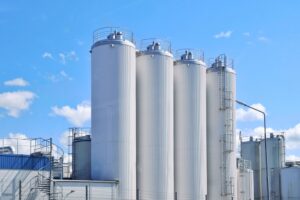
Dairy facility ammonia odor occurs when ammonia-containing or ammonia-forming materials release gaseous ammonia into the surrounding air. At dairy processing plants, potential sources can include wastewater treatment, residual milk proteins, sludge handling, waste storage, drains, and other areas where nitrogen-rich organic material is collected or decomposes.
Effective ammonia odor control starts by identifying where the ammonia is being generated, measuring the emissions, and determining how the gas is being released and dispersed.
Why Does a Dairy Facility Smell Like Ammonia?
Ammonia can form when nitrogen-containing organic materials break down.
Dairy processing facilities generate wastewater and residual streams containing milk, proteins, fats, cleaning water, product losses, and other organic materials. EPA identifies equipment cleaning, spills, processing losses, spoiled or returned product, sludge, and cleaning compounds among the principal waste streams generated by dairy processors.
As these materials move through wastewater collection, equalization, treatment, sludge handling, or storage processes, conditions can develop that promote the formation or release of ammonia.
The source may therefore be located outside the primary production area.
Potential ammonia odor sources at a dairy processing facility include:
- Wastewater collection systems
- Equalization tanks and basins
- Drains and sumps
- Wastewater treatment processes
- Sludge handling and storage
- Product residuals and spills
- Organic waste containers
- Byproduct storage
- Process exhaust
- Certain cleaning or sanitation operations
Ammonia problems can also change with plant production levels, wastewater loading, temperature, pH, airflow, and treatment-system operation.
That variability is one reason ammonia odor problems should be investigated under representative operating conditions rather than diagnosed from a single walk-through.
What Does Ammonia Odor Smell Like?
Ammonia has a distinctive sharp, pungent odor.
When employees or nearby properties report an ammonia-like smell, however, odor perception alone should not be used to confirm that ammonia is the only compound involved.
Dairy processing odors may consist of multiple compounds released simultaneously. Depending on the source, other contaminants could include volatile organic compounds, sulfur compounds, or compounds produced through the decomposition of organic material.
WEA therefore uses air and liquid sampling, concentration measurements, source evaluations, and other analytical techniques when investigating ammonia odor rather than relying only on smell.
The important question is not simply: “Can we smell ammonia?”
It is: “How much ammonia is being released, from which sources, under what conditions, and how much does each source contribute to the facility’s overall odor impact?”
Where Does Ammonia Come From in Dairy Processing Wastewater?
Wastewater is one of the first areas that should be evaluated when a dairy processing plant develops persistent ammonia odors.
Dairy wastewater can receive material from:
- Milk and whey losses
- Tank and piping rinses
- Equipment cleaning
- Product changeovers
- Production spills
- Spoiled product
- Sludge and suspended solids
- Organic residuals
EPA specifically identifies cleaning, processing losses, product wastage, spills, and cleaning compounds as major dairy product waste streams.
Once this material enters the wastewater system, its characteristics continue to change.
Nitrogen-containing compounds can be transformed through biological activity. Ammonia can then exist in the liquid stream and, under certain conditions, transfer into the air.
Recent research has specifically examined ammonia-nitrogen removal and recovery from dairy processing wastewater, underscoring the relevance of ammonia management within dairy wastewater treatment.
For odor-control purposes, engineers therefore need to consider both the liquid and vapor phases.
Treating only the air may overlook opportunities to prevent ammonia from being generated or released in the first place.
What Conditions Can Increase Ammonia Release?
The amount of ammonia that moves from wastewater or another liquid source into the surrounding air does not remain constant.
Several operating conditions can influence ammonia generation and release.
Wastewater Chemistry
Changes in wastewater chemistry can affect how ammonia behaves between the liquid and gas phases.
This means a wastewater process that normally produces little noticeable ammonia odor could become considerably more problematic when its chemistry changes.
Temperature
Temperature can influence biological activity and the transfer of volatile compounds from liquids into air.
Seasonal conditions or warm process streams may therefore change the way an ammonia source behaves.
Organic and Nitrogen Loading
Variations in production can change the amount of organic and nitrogen-containing material entering the wastewater treatment process.
High or irregular loading can create different conditions than those observed during normal production.
Retention Time
Wastewater that remains in tanks, basins, drains, or other collection areas for extended periods can undergo additional biological and chemical changes.
Mixing and Aeration
Agitation can affect how dissolved or volatile compounds are released from a liquid surface.
Consequently, an ammonia problem may become most noticeable at a particular tank, transfer point, aerated process, or discharge location even when the ammonia originated earlier in the wastewater system.
How Do You Find the Source of Ammonia Odor at a Dairy Facility?
A successful ammonia control project begins with source identification.
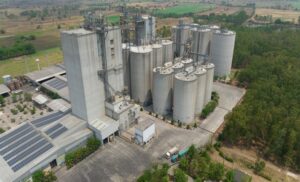
Installing treatment equipment before understanding the emissions can lead to oversized systems, undersized systems, unnecessary operating costs, or treatment technology that does not match the actual contaminant load.
WEA’s approach to ammonia odor investigations begins with site-specific evaluation and can include air sampling, liquid sampling, concentration measurements, airflow assessment, facility-layout evaluation, and dispersion modeling.
1. Develop an Odor Source Inventory
Potential ammonia sources throughout the dairy facility are identified.
This can include processing areas as well as wastewater, residuals handling, storage, and ventilation systems.
2. Measure Ammonia Concentrations
Air sampling helps determine where ammonia is present and at what concentrations.
Measurements can also be collected at multiple operating conditions to determine how emissions change throughout production.
Evaluate the Liquid Phase
If wastewater or another liquid process is suspected, liquid sampling can help engineers understand the conditions contributing to ammonia formation or release.
Measure Airflow
Concentration alone does not tell the entire story.
A relatively concentrated source with very little airflow may have a different total emission rate than a larger source releasing more air at a lower concentration.
Both concentration and airflow therefore matter when comparing sources.
5. Rank the Sources
Once data has been collected, individual sources can be compared according to their contribution to the overall problem.
Source ranking helps direct capital spending toward the processes that matter most.
How Does Air Dispersion Modeling Help with Dairy Ammonia Odor?
An ammonia source inside a dairy plant does not automatically produce the same odor impact beyond the property boundary.
Once ammonia or other odor compounds enter the atmosphere, their movement can be affected by emission characteristics, building configurations, release locations, and weather conditions.
Air dispersion modeling can help evaluate how facility emissions travel and where impacts may occur. WEA uses dispersion modeling as part of site-specific odor evaluations to determine which sources require the greatest attention and to assess potential control strategies.
This can be particularly useful when a dairy facility is investigating:
- Neighborhood odor complaints
- Intermittent ammonia odors
- Specific wind-direction patterns
- Proposed equipment changes
- New exhaust locations
- Facility expansions
- Odor control system upgrades
Instead of assuming that the closest odor source is responsible for a complaint, modeling helps connect measurable emissions with atmospheric conditions.
How Can Ammonia Odor Be Controlled at a Dairy Facility?
There is no universal ammonia odor control system that is best for every dairy processing plant.
The appropriate solution depends on factors including:
- Ammonia concentration
- Total emission rate
- Airflow
- Source configuration
- Temperature
- Humidity
- Variability in leading
- Other odor compounds present
- Available footprint
- Required performance
- Capital costs
- Operating and maintenance requirements
WEA evaluates multiple treatment technologies rather than recommending a predetermined piece of equipment. Its existing ammonia-control work includes chemical scrubbing, biological treatment, containment and capture, and other site-specific approaches.
Chemical Scrubbers for Dairy Ammonia Odor
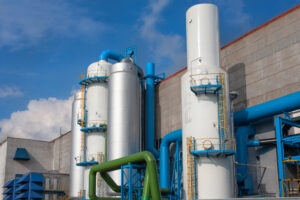
Chemical scrubbing can be particularly useful when ammonia is present in a captured air stream.
In an acid scrubber, contaminated air is brought into contact with an acidic scrubbing solution. Because ammonia is alkaline, it can be absorbed and converted into an ammonium salt within the scrubbing liquid.
WEA identifies acid-based chemical scrubbers as one of the common approaches for treating ammonia-containing air streams.
Scrubber design must account for actual facility conditions, including:
- Airflow
- Ammonia loading
- Desired removal efficiency
- Chemical consumption
- Pressure drop
- Contact time
- Material of construction
- Maintenance requirements
Simply specifying a scrubber without accurate emissions data can result in poor system performance.
Can Biofilters Remove Ammonia Odor?
Biological treatment may also be appropriate for certain dairy ammonia sources.
Biofilters and biotrickling filters use microorganisms to transform biodegradable compounds within the contaminated air stream.
WEA uses biological treatment for suitable ammonia applications, particularly where loads and operating conditions are compatible with biological processes.
Biological systems depend on maintaining appropriate conditions for microbial activity.
Important design and operating considerations can include:
- Moisture
- Airflow
- Contaminant loading
- pH
- Temperature
- Media condition
- Nutrient balance
Large changes in ammonia loading may require particular attention because biological treatment depends on maintaining a stable microbial population.
Can Activated Carbon Control Ammonia?
Adsorption media may be considered for certain ammonia applications, particularly when contaminant concentrations and air-stream characteristics are appropriate.
However, media selection matters.
An adsorption system should be designed around the specific contaminants rather than assuming that a general-purpose carbon will provide adequate ammonia removal.
WEA evaluates activated carbon and other adsorption approaches as part of a broader technology-selection process when the air stream and treatment requirements make adsorption appropriate.
Should the Ammonia Source Be Enclosed?
Sometimes the biggest obstacle is not treatment technology. It is capturing the contaminated air.
Open tanks, basins, processing equipment, drains, and waste-handling areas can allow ammonia-containing air to disperse before it reaches an odor-control system.
Covers and enclosures can help isolate a source.
The captured air can then be conveyed through ductwork to a scrubber, biofilter, biotrickling filter, adsorption system, or another appropriate treatment process.
WEA specifically uses containment and airflow strategies alongside ammonia treatment technologies because effective capture can significantly influence the performance of the overall odor control system.
An odor control system cannot effectively treat emissions that never reach it.
Is It Better to Control Ammonia in the Wastewater or in the Air?
Where possible, the most effective strategy may involve reducing ammonia generation or release before relying entirely on vapor-phase treatment.
For a wastewater-related ammonia source, engineers may evaluate whether process changes or liquid-phase controls can decrease the amount of ammonia reaching the air.
A layered approach can therefore look like:
Reduce formation → limit release → contain emissions → capture contaminated air → treat the air → verify performance.
Not every facility will need every step.
The objective is to determine which combination achieves the required odor reduction with reasonable capital and operating costs.
Why Doesn’t More Ventilation Solve an Ammonia Odor Problem?
Increasing ventilation may improve conditions in the immediate process area, but ventilation by itself does not destroy ammonia.
If untreated ammonia-containing air is simply exhausted outdoors, the facility may transfer the odor from an indoor location to the surrounding environment.
Effective ventilation should therefore be considered as part of an integrated capture and treatment strategy.
Duct sizing, fan selection, collection points, enclosure design, and air balance all affect whether emissions reach the odor control equipment. WEA notes that even an effective scrubber or biofilter may fail to solve a problem if contaminated air is not properly collected.
How Do You Choose the Best Ammonia Odor Control System?
The best ammonia treatment technology is determined by data—not by selecting equipment first and testing afterward.
Before choosing a system, dairy facility operators should be able to answer questions such as:
- Where is the ammonia being generated?
- What are the ammonia concentrations?
- How much contaminated air must be treated?
- How variable is the ammonia loading?
- Are other odor compounds present?
- Can emissions be prevented or reduced at the source?
- Can the source be enclosed?
- What removal performance is required?
- What are the long-term operating costs?
- How will performance be measured after installation?
Without this information, comparing odor control technologies becomes difficult.
A solution that performs well at one dairy facility may perform poorly at another because wastewater chemistry, airflow, production schedules, facility layouts, and contaminant loads differ.
Why Ammonia Testing Should Come Before Equipment Selection
Persistent ammonia odors sometimes prompt facilities to immediately request a scrubber, carbon unit, or biofilter.
That skips an important step.
Testing may show that:
- The ammonia source is different from the one originally suspected.
- Several smaller sources are contributing to the problem.
- The existing collection system is inadequate.
- Ammonia concentrations vary dramatically during production.
- Another odor compound is contributing to the perceived odor.
- A process change could reduce the contaminant load.
- Existing equipment is appropriate but operating under the wrong conditions.
Identifying these issues before purchasing equipment can prevent expensive corrections later.
WEA’s odor-control philosophy emphasizes site-specific sampling, testing, source identification, and engineering analysis before selecting treatment technologies.
Building a Dairy Facility Ammonia Odor Control Strategy
Dairy facility ammonia odor is rarely solved effectively through guesswork.
The strongest approach follows a logical progression:
- Identify potential ammonia sources.
- Measure air and, when appropriate, liquid conditions.
- Calculate and rank emissions.
- Evaluate how the emissions are captured and dispersed.
- Identify source-control opportunities.
- Compare suitable odor control technologies.
- Design the collection and treatment system around actual conditions.
- Test performance after implementation.
This process turns an odor complaint into a measurable engineering problem.
For a broader examination of odors generated throughout milk and dairy processing operations, see WEA’s Dairy Processing Facility Odor Control guide.
Facilities evaluating the overall air environment within a milk processing operation can also review Milk Processing Plant Air Quality.
FAQ – About Dairy Facility Ammonia Odor
Ammonia odor can develop when nitrogen-containing materials break down or when ammonia present in wastewater or other process streams transfers into the air. Potential sources include wastewater treatment, drains, tanks, sludge, residual dairy products, and organic waste.
Dairy wastewater contains organic and nitrogen-containing material originating from milk products, processing losses, cleaning operations, sludge, and waste streams. Ammonia-nitrogen can therefore become relevant during wastewater treatment and has been specifically studied in dairy processing wastewater.
Air sampling, liquid sampling, ammonia measurements, airflow measurements, source inspections, and operating-data review can be used to identify and compare potential sources. Air dispersion modeling may also help determine how emissions travel beyond the facility.
Depending on the air-stream characteristics, ammonia may be treated using acid-based chemical scrubbing, biological treatment, specialized adsorption media, or a combination of technologies. The best option depends on measured concentration, airflow, loading, and other site-specific conditions.
Biofilters can treat ammonia under suitable loading and operating conditions. Maintaining moisture, airflow, pH, media condition, and other biological requirements is important for reliable performance.
Ventilation can capture and move ammonia-containing air, but it does not eliminate ammonia by itself. Where off-site odor is a concern, captured air may need to be routed to an appropriate treatment system.
Performance testing can compare inlet and outlet conditions, removal efficiency, emission rates, and other relevant parameters. WEA performs post-installation testing to verify odor-control system performance and identify opportunities for optimization.
I am text block. Click edit button to change this text. Lorem ipsum dolor sit amet, consectetur adipiscing elit. Ut elit tellus, luctus nec ullamcorper mattis, pulvinar dapibus leo.